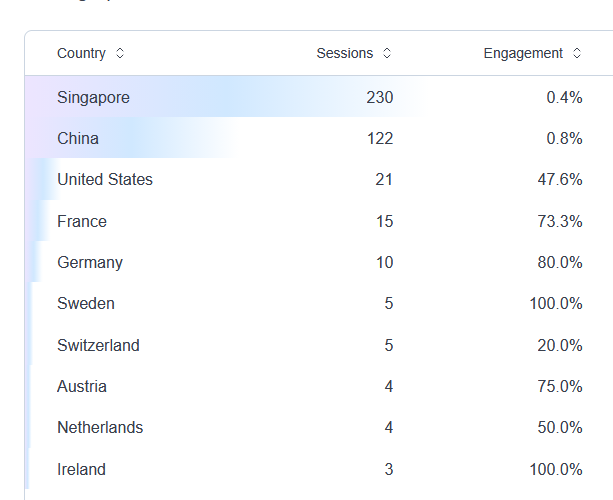
Attached are the sessions from the last 30 days.
In early 2026, it was China that regularly accessed the site, viewing all the pages from the past. A thorough analysis—though I can’t figure out what they got out of it.
In recent weeks, Singapore has been the leader in terms of access.
Over the past week or two, Europeans have been accessing the site in a disciplined but unenthusiastic manner. One country (likely Germany or Spain) shared some information with colleagues, including a few links. One or two people from each of these European countries accessed it—no more. Europeans are a bit peculiar. On their part, this isn’t an enthusiastic embrace of new ideas, but rather a polite gesture among well-mannered people who react very slowly and rather superficially. They will be surprised to find that others have already gotten a head start on the subject. They access it because someone sent them something, but their engagement and reflection are measured. It will likely take them weeks or months before they make any decision on the matter. … only to be surprised that they have already fallen considerably behind others
The contact form is never used: no one ever asks any questions.
There are between 5 and 30 visits per day, no more.
When you look at the articles from April 6 and 7 on the Persian Gulf Council, it seems odd. It appears to have hit the mark, but in practice, none of the Arab countries directly involved accessed it. It may have had an effect elsewhere and indirectly. Since there were only 5 or 6 visits on those days, the user who accessed it remains unidentified, but no country that should be directly concerned has done so. It’s a multi-cushion billiards game: it’s not the one who accesses it who does anything with it. And the one who does something with it will make sure to remain unknown.
April 8, 2026