This website is a platform for sharing research that focuses primarily on the Clock of the Unconscious but draws on influences from various fields:
- Psychology & Psychoanalysis: The main contribution of the Clock of the Unconscious is to demonstrate the existence of a phenomenon of recurrence, following a cyclical pattern. This can either help predict future reactions or assist in identifying the “source” of distress or a crisis. Possible applications lie in the field of psychotherapy. Psychoanalysis is reduced to a few basic psychoanalytic concepts and de-sexualized so that it can be applied equally to individual psychology and collective sociology. This is a promising avenue for the future that has not yet been explored and will require preparatory work.
- Sociology and politics: this involves the analysis of the collective unconscious and the insights that can be drawn from it within the framework of applications of the “Theory of Return.”
- Wars & the “Quésako Cycle”: One of the applications of the “Theory of Recurrence” is the “Quésako Cycle.” This cyclical phenomenon is described in the book A Cyclical Phenomenon That Promotes Wars, published in July 2025 by L’Harmattan (in french). This section is, for the time being, the most advanced part of this research. It provides essential information for making reliable predictions about wars, even several years before they break out.
- Wars and Conflict Resolution: This involves analyzing and providing advice on conflicts for which there is sufficient information to make such analysis relevant. There are major wars for which it is impossible to obtain reliable information without specifically deploying teams to the field to understand the situation and take action. Among these wars, Sudan and Yemen warrant urgent, specific studies. Current resources (other than those the author can devote to this effort) do not allow for sufficient investment in these areas or for the provision of credible and reliable advisory services.
Certain current conflicts (the Arab-Israeli conflict, Russia-Ukraine, the Persian Gulf, etc.) have preliminary studies that are sufficiently developed to serve as a basis for proposals. These preliminary studies are not formally accessible and will only become so if there are identified partners willing to commit to launching an official, sustained initiative. For example, preparations for maintaining the Russia-Ukraine ceasefire could begin immediately, based on experience already gained. What is lacking are one or more motivated partners.
Topics that have already been published (in journals or books) are not covered here. Notes are published in the “News notes,” which address ongoing developments or draft topics still in the works.
This site is limited to current research. It does not aim to cover every possible topic.
The main documents available can be found in the “Available Documents” section.
Edition 2025
This book is published, in french, by L’Harmattan, in print and electronic formats.
A checked translation in US-english is temporary available here : “A cyclical phenomenon that favors wars?“. As soon as there is a publication by a publisher, this current translation wwill not be available.
Be careful : graphs, texts are up to date only in the book (french or US-english).
It is a comprehensive update on everything related to wars.
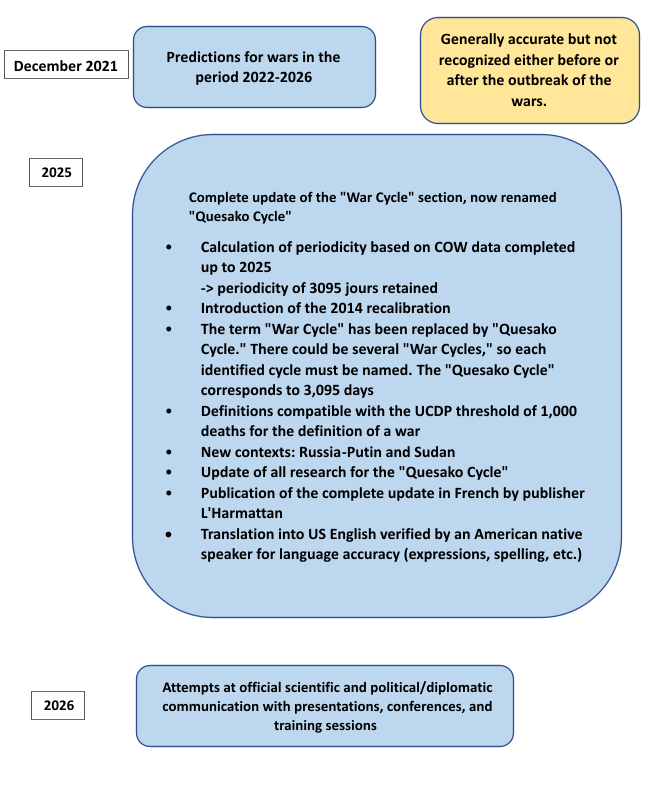
All pages on this site relating to the “War Cycle” have been removed. No updates will be made to this site for the section covered by the book. The “War Cycle” has been renamed the “Quesako Cycle.” It is a “War Cycle” lasting approximately eight and a half years.
Graphs and text published prior to the book’s release are still accessible via the search tool, but they are not up to date. Please use the checked translation of the french book.
__________________________________________________________________________
2026 Program
- Presentations/training sessions on the “Quesako Cycle”
Presentations (lasting from 1 to 4 hours) are available. Priority will be given to research centers and universities, as well as international organizations. This is a subject with potential for further research. Presentation costs (transportation, accommodation) must be covered. Preference is given to 3- to 4-hour training sessions for groups of 20 to 30 people. Presentations/training sessions are available in French but can also be performed in English. - Find a publisher for the US English version
We need an international version. The US English version has been checked for language. It has been reviewed by an American, former literature professor, who has ensured that the writing is correct in US English. This is the international reference version in 2026, as a few updates and corrections have been incorporated.
If there are other translation requests, they will be handled by the publisher L’Harmattan. - Creation of an international steering committee
Much additional research can be carried out, and the idea is to maintain international coordination in the launch and publication of research. This is open to researchers from any country. To date, there is no funding other than that which interested researchers will obtain. If there are donors, a foundation will be created to collect donations for research.
The international steering committee will be composed of volunteers who come forward. - Resumption of research on the Clock of the Unconscious
If the above points are achieved, the research that led to the “Quesako Cycle” will be resumed and completed. The goal is to have a reference version ready by 2027. There have already been two editions of the Clock of the Unconscious: one in 2003, which is still available, and another in 2012, of which there are about a hundred copies left.
————————————————————————————————————————–
A cyclical phenomenon that has an influence on our collective behavior and in particular wars?
It is necessary to open a debate on the subject, to bring elements for or against to make mature this subject which influences us without most of us being conscious of it.
How can we summarize this cyclical phenomenon in a few lines?
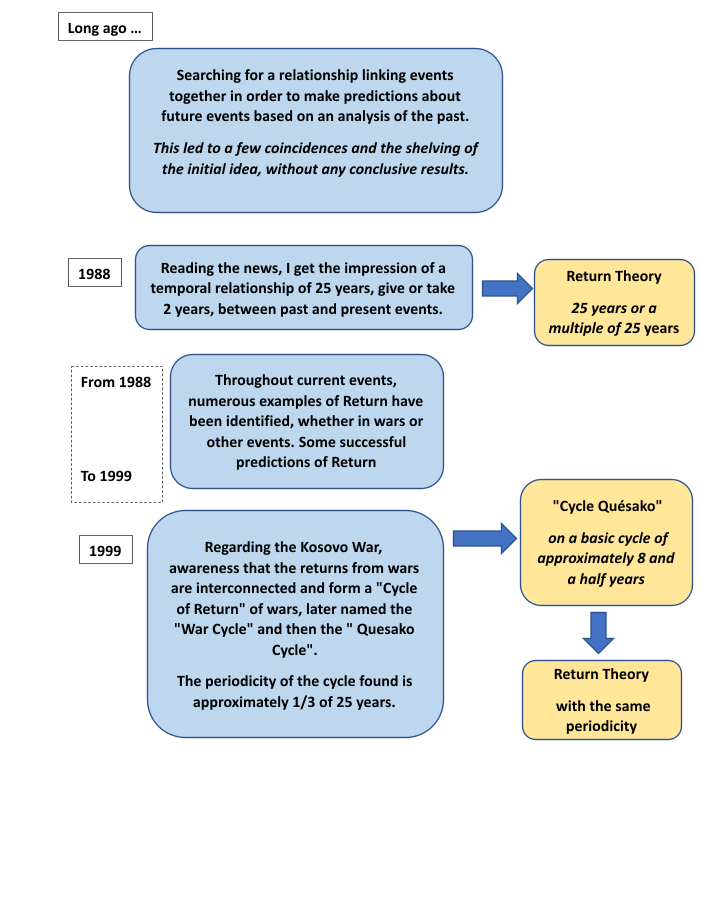
A cyclic phenomenon has been identified: the cycle is about 8 and a half years or a multiple and most often 3 times, that is to say a little more than 25 years or a multiple of 25 years.
This periodic phenomenon can be expressed in different ways
- It can bring back the past but in a distorted and most often unconscious form. This phenomenon is called “Return of the past”.
- It can exacerbate tensions and favor wars or escalations.
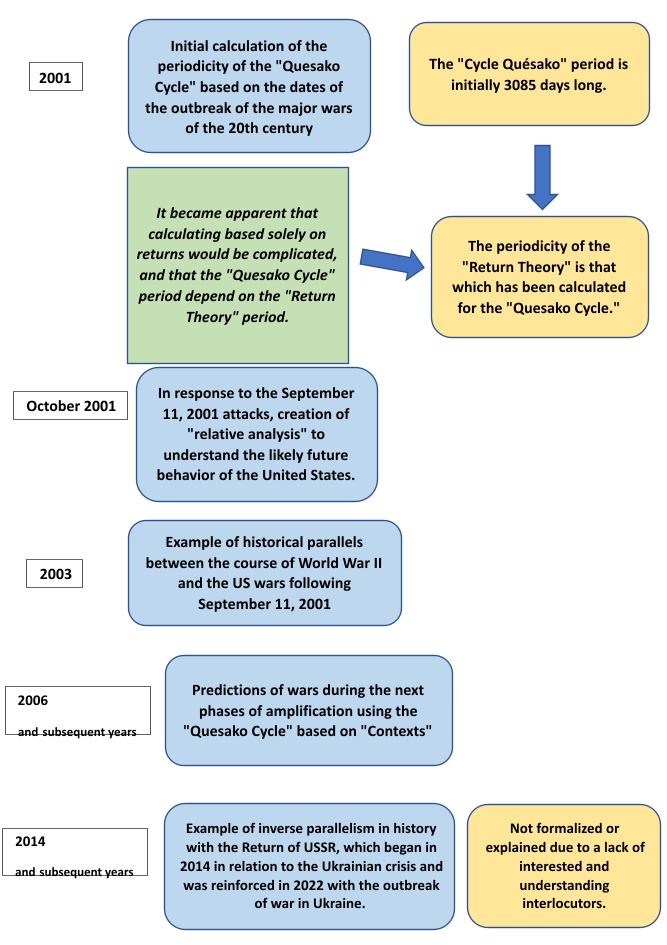
- It can, in exceptional cases, give the impression of a certain parallelism of history. This subject is just mentioned here but not yet explained on this site
What is the interest of such a cyclic phenomenon?
The first one is to notice that collective events, like crises or wars, which seem to be unpredictable, follow a logic which can only be understood by taking cognizance of this cyclic phenomenon. It is fascinating to see this. It is disturbing to admit it. It can give some people the impression of a formidable regression of thought which returns to a world where we imagined, in the Middle Ages, a great hidden clockwork which guided our destiny. This phenomenon has an influence but is not deterministic.
What are the stakes of these studies?
We can imagine, based on current knowledge, that most of the major wars of the 20th and 21st centuries have an additional cause that is unconscious today and that is this cyclical phenomenon. We do not yet know the real origin of this phenomenon. Presumably it is not as regular as a beautiful mathematical sinusoid.
If further studies were to confirm this, it would shed a new light on all those wars which we thought were defending a just cause but for which one of the important causes had not been identified until now. All this has not yet been demonstrated in an incontestable way and can only be demonstrated if other researchers take up these studies.
Another issue could concern the whole of the human sciences. Is it a fundamental mechanism that we could find in psychology, sociology, psychotherapy? This would presuppose applied research in fields other than wars and the jolts of history caused by the collective unconscious.
Overview of the historical evolution of concepts
updated on September 29, 2026