Several coordinated events have taken place in Saudi Arabia over the past few days:
- attacks on Saudi Arabian territory, resulting in numerous casualties,
- the gradual takeover of the Bab el-Mandeb Strait,
- an attack on Saudi Arabia’s East-West pipeline by Iranian militias on Iraqi territory.
These events are certainly coordinated by the Revolutionary Guards.
When we ask ourselves who authorized them to carry out these actions, we arrive at the conclusion that there is a permanent parallel power structure, one that is not subject to day-to-day oversight by the executive branch represented by President Pezeshkian.
The key to a potential return to calm in the Strait of Hormuz lies in this uncontrolled parallel power structure.
It is this power structure that decided to launch military attacks against oil tankers that are not authorized or controlled by Iran.
It is this power structure that initiates most military actions.
Unless this parallel power is brought back under political control, any agreement will be torpedoed in the same way as the June 17 agreement: the Guardians of the Revolution will invent a rule that is not part of any agreement in order to launch a new military action.
Theoretically, next Monday, an agreement will be signed between Iran and Oman in the presence of the Gulf states’ foreign ministers regarding shipping lanes in the Strait of Hormuz.
This agreement, if implemented, will be contingent on the measures taken in the event of a dispute. A traffic control body for the Strait would be needed to handle ships that do not comply with these new shipping lanes. If this system is not established, the Revolutionary Guards will deem it necessary to militarily neutralize these ships.
If this system were established, there would be several means of intervention:
- radio communication (on mandatory frequencies during the crossing)
- inspection vessels dispatched specifically to the ships
Presumably, this point will be sidestepped in the Oman-Iran agreement, which will likely render it null and void.
What can Saudi Arabia do?
Saudi Arabia is trying to get the United States involved, though the U.S. initially refused.
Saudi Arabia could “put its foot in it” by asking the Supreme Leader, through Pezeshkian, to arbitrate this apparent attempt to drag Iran and Saudi Arabia into all-out war.
Will they do so? It is not in Saudi Arabia’s current practice to launch a strong diplomatic initiative that could be seen as a sign of military weakness.
In any case, we’re going to have to address this reality of parallel powers in Iran
If so many people died in January in Iran during the crackdown on protests, it is also because of this parallel power structure, which is incapable of using non-lethal riot control measures and knows only one way to act: to kill and destroy, whether the targets are Iranian citizens or civilian merchant ships.
The reason the June 17 agreement was derailed was, in the first place, because someone decided to launch a military attack on civilian ships. Iranian officials acted as if this event had never happened, in order to highlight the U.S. military retaliation—which was also a violation of the agreement—but the U.S. retaliation was the consequence of the initial violations initiated by the Revolutionary Guards, without prior oversight by Iran’s political leadership.
Initiating a resolution to this problem would require diplomats to dare to corner the Iranian political leadership, represented by President Pezeshkian and the Supreme Leader. As a complete unknown, it is utterly impossible for me to do so. My thoughts are not conveyed to anyone within the Iranian government.
September 12, 2026
Naej DRANER
Post sriptum:
During the early years of the Islamic Republic, the government was wary of Iran’s military and security structures. That is why the Revolutionary Guards were created—as a parallel power that could be activated by the Supreme Leader without being controlled by the executive branch. The Basij militias follow the same logic. They are responsible for the massacres of January 2026. Even though the Islamic Republic denies the reality of these massacres, they will remain an indelible stain on the mullahs’ incompetence in peacefully managing the upheavals of Iranian civil society. Theoretically, the Supreme Leader has the power to act. The Supreme Leader’s security representative is traditionally the secretary of a kind of Iranian Security Council, which theoretically enables him to act. However, this would require the Supreme Leader to be well-informed and concerned about concrete security issues—such as the suppression of unarmed protesters by militias and military forces equipped to kill rather than to peacefully quell unrest. Nothing in the statements reported by the Iranian media (particularly Iran International, which is the best source I know of for news from Iran) suggests that the Iranian Supreme Leader is aware of this structural dysfunction in Iran.
Postscript, September 13, 2026:
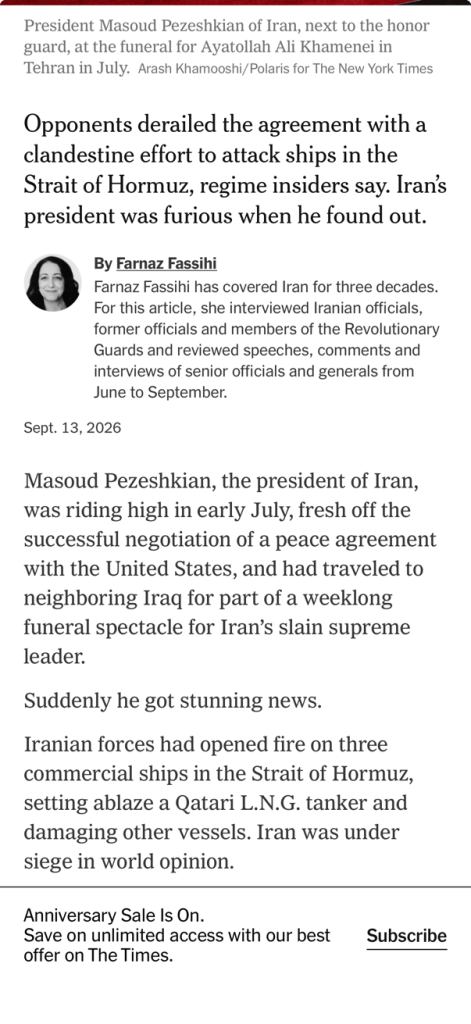
On September 13, The New York Times published an article confirming that it was indeed a deliberate act by factions opposed to the agreement with the U.S. that derailed the June 17 agreement. The same is likely true of the current attacks against Saudi Arabia, whether they come from the Houthis or from Iraq.