Category Archives: Uncategorized

Is it useful to anticipate the risks of war?

In principle, YES, if we want to avoid them. In practice, NO: the forecast is dismissed, and the failure to acknowledge the “Quésako Cycle” means that it isn’t even assessed or recognized.

In Appendices 5 and 6 of the book A cyclical phenomenon that favors war?, there are two partial excerpts from the predictions made in late December 2021 regarding the risks of war in Europe and in the Arab-Israeli conflict. The risks of war have been confirmed by the facts.

No one took into account the risks of war described in late 2021

There are many reasons:

  • First, there were no publications in credible journals, nor even any book publications, prior to 2025,
  • The majority of Western (and even non-Western) researchers have, until now, viewed this research with indifference—research that hasn’t even been peer-reviewed (at least, the lack of reaction leads me to believe that no one is interested in it),
  • No one other than the author has dared to give even a partial presentation showing that they have understood it,
  • This is not a single new concept (like the “Quésako Cycle”), but rather several different and new concepts that enable understanding and forecasting (contexts, modeling, forecasting rules, etc.). It’s too many things at once.
  • No further research has officially been initiated on the subject, or if it has begun, the author has not been informed—as if the original work were to be ignored.

No known scientist officially endorses the reality of the “Quésako Cycle”

There are many reasons:

  • It is not known whether a book summarizing the entire research project has been published in French,
  • despite a translation into American English, no publisher has come forward for this version;
  • as the author, I have not yet submitted an article on the subject, somewhat discouraged by the often negative responses I’ve received. While officially any article can be read and submitted to a peer-reviewed journal, experience shows that related information—such as the non-academic nature of the research—is enough to prevent the proposed work from even being read or submitted to a journal,
  • and every scientific researcher is primarily concerned with their own research and activities. For these researchers, evaluating the unpublished work of others is a waste of time.

What can be done to raise awareness and gain recognition of the reality of the “Quésako Cycle” and the predictions that can be made about the risk of war?

  • If readers would speak up and at least explain what did or did not convince them, we would have leads to follow up on;
  • a lively debate would help move things forward, but there isn’t one;
  • a publication in a specialized journal is necessary.

Can leaders and politicians help bring all of this to light?

The example of France is not encouraging. The letters sent to several French prime ministers clearly showed that they had been received, but those prime ministers merely forwarded them to their defense ministers, who did nothing with them. French lawmakers are too preoccupied with one political crisis after another to do anything about it.

Of course, they could all help, but that would require giving the matter some credibility, which is not the case.

Is it useful to continue making predictions about the risk of war that are then confirmed by actual wars?

Today, no one is making use of it, so it’s of no use. The question that openly arises is whether we should continue, without a budget and without recognition.

Furthermore, in a war like the one launched on October 7, 2023, by Hamas—and which continues in various forms—taking the reality of these forecasts and research into account could have changed things. Even though an Israeli-American woman said that I predicted what the Mossad was unable to predict, it is unlikely that the Israelis will ever be aware of the connection between their war and the “Quésako Cycle.”

It is not the validity of this research that is in question, but the near impossibility of bringing it to the attention of those who might be directly interested. There is too great gap between what can be predicted and what contemporary culture is willing to accept as true. In other words, no one believes in it enough to officially support it or even have it evaluated.

June 18, 2026

Letter received from the office of the French Prime Minister:

These letters merely state that the French authorities have been informed.

Update as of June 20, 2026

The dossier submitted in early 2023 contained a war forecast for the Arab-Israeli conflict. To my knowledge, it was not acted upon.

A letter sent in December 2025 to the Minister of the Armed Forces proposed launching an objective assessment. A response was received, but nothing concrete came of it. It was likely not evaluated at all, or only in a caricatured and superficial manner, as is often the case. Although the Ministry of the Armed Forces directly or indirectly funds most studies on warfare, it is a closed circle that appears incapable of evaluating original work or even providing recognized added value at the international level. An organization like IRSEM has a scope that could encompass this research. Presumably, none of the researchers at IRSEM are aware of this, and the same could be said of some university laboratories. Are they right to bury their heads in the sand regarding the “Cycle Quésako”? The question doesn’t even arise, since the subject has been consigned to the dustbin of history, without anyone in these French circles having understood what it was all about. It is very difficult for an independent researcher outside of an institutional framework to communicate or have original work with recognized results evaluated. The culture of French elitism tends to ignore anything that does not come from recognized elites. These are the very same people who will be outraged if foreign researchers were to take up or build upon this work, should that ever happen.

What future for Gaza?

In view of the result presented on February 26, 2025 of the Israeli army’s internal investigation, which acknowledges its full responsibility for the fiasco of October 7, 2023, we can try to do our job as architects. There will be no other channel of communication and proposal than this one

Israel, with the help of the American negotiator, has modified the conditions that could lead to a lasting ceasefire. The only proposal is for an extension of the truce, which means that, in any case, whether today or in a month and a half, Israel intends to resume the war in Gaza. Under these conditions, Hamas is reluctant to let its last hostages go.

Is the USA capable of playing the negotiator while being aligned with Israel? Probably NOT.

Apart from Trump’s proposal, which is a form of ethnic cleansing in disguise, the United States has nothing to propose or negotiate. Can the real estate developer already see himself having the reconstruction work done by countries other than his own, and selling all the rebuilt real estate on his own account? It’s a bit grotesque, but Donald believes in it, and so does Bibi. An unattainable, idiotic dream.

So, what’s the plan? An Arab plan? Maybe, but we’ll have to rework it and turn it into something credible and manageable.

What about security? Can Israel provide security? Israel ensures Gaza’s insecurity, as well as its destruction. It is impossible for Israel to provide security. Israel will destroy any embryonic visible security forces.

Is a temporary trusteeship of Gaza possible? It would be a good solution, but who would risk doing it? and how?

It would be preferable for Gaza’s security to be temporarily assured by an external third party, which cannot be Israel or the United States. But how? An international police force? NO, sending in foreigners who don’t speak the language is never effective. What’s more, we need to rebuild a security system. The best we could do is to have police force trainers in sufficient numbers (1,000 to 2,000) to train, on the spot, new security forces from the local population, whether or not they are from Hamas, but controlled by external agents. Is this possible? It’s never happened internationally, because it’s never been tried. It will be fragile for 6 months, then maybe it will work.

Then we’d have to set up an inspection body made up of: one third international, one third Palestinian and one third Israeli. These inspectors must have access to everything that happens. The aim is to be able to see everything that’s going on, and react in ways other than new bombings. We’d need 100 to start with, rising to 500. What’s the difference between an inspector and an observer? The observer observes and does nothing. The inspector observes and takes steps to rectify what has been observed, relying on the new security forces.

Is this realistic? This could only happen with the cooperation of Arab countries and a few others.

A bottle in the sea that won’t wait for its recipients? Perhaps, but between ethnic cleansing and new bombings, something else must be tried.

Naej DRANER

ND2025-001, March 3, 2025

Naej DRANER is an analyst. He is an architect of a political-security solution who limits himself to the role of architect. His analyses are generally a preparation for the day after and a solution for the short, medium and long term. To build a house, you need an architect, but you also need a contractor. N.D. is not a contractor and can only have an influence if he joins forces with a contractor to design and implement a suitable political-security solution.

Ukraine: Status of the ceasefire of 27 July 2020

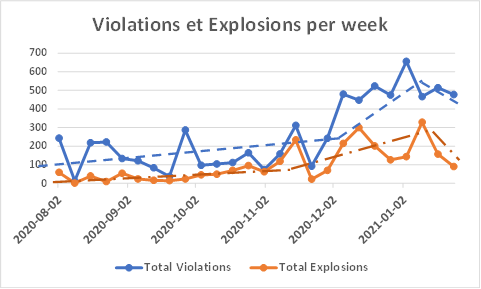
To summarize the situation, take a look at this graph. It is the weekly sum of weekly violations and explosions since that date.

In addition, days without any violation since that date can be taken into account:

  • 8 in August
  • 0 in December and January until January 24, 2021

There has been a slight overall improvement in the last 2 weeks. Awareness seems to have started. A TCG meeting was held on January 21. A press release reported discussions but apparently no publishable decisions.

The Luhansk sector has had very few violations in the last few days, but the Donetsk sector reached a record this last weekend. Apparently they are not in phase and do not do the same thing from one sector to the other

When one reads the communiqués of each camp, there is uneasiness and many of the elements accepted in the January 22nd agreement no longer work:

  • the parties had undertaken not to respond to shots received unless ordered to do so by their command at the highest level. This is no longer the case: there is a systematic return,
  • The JCCC had been presented as an arbiter of violations: it seems that it merely relays the information to the MMS, which itself, as usual, does little more than relaying this information with delay in an unidentified form and frequency, except for public reports that are between 24 and 72 hours late on events, depending on the day they are published,

The officially available information is too partial to be sure of what is going on, but it is probably not much. The local actors seem to apply principles that they apparently did not understand, perhaps because they were not explained to them and perhaps also because there is a lack of a kind of coach for all the actors in the field (JCCC and SMM).

If any of you know SMM observers or members of the JCCC, please allow contact to be made so that we can verify some of the information needed to readjust the ceasefire.

Naej DRANER (naej.draner@gmail.com)

January 26, 2021

Find out more: