Have you read the book “A Cyclical Phenomenon that favors Wars” by Jean-Baptiste Renard, published by L’Harmattan? ( in french but you can find a translation here)
A book that experts on war and peace should have understood. A cyclical phenomenon whose understanding allows us to predict wars and better understand contemporary conflicts. It is the “Quésako Cycle.” Not some esoteric joke, but rigorous, well-reasoned research presented in an engineer’s style that won’t let up until everyone has understood it.
This book examines various contexts, such as the Russia-Putin context that is of interest to us here, and for which you have the chart below. (If you do not understand the chart, please refer to the book, where everything is explained.)
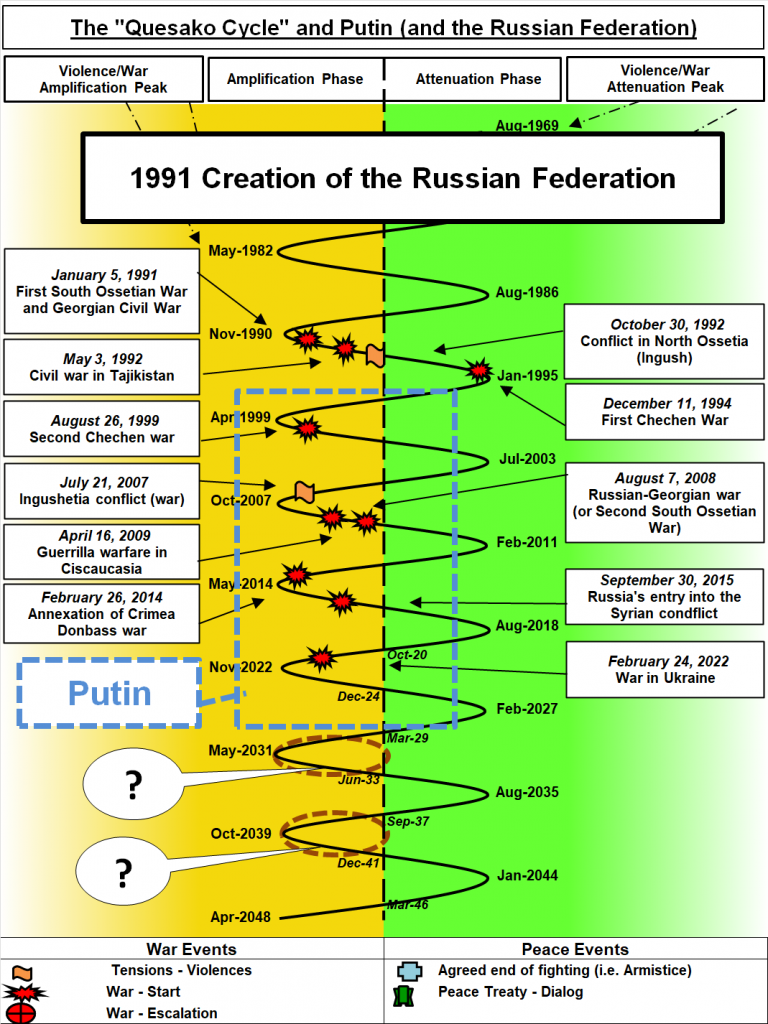
The author rightly points out that what sets Russia apart is that it has experienced multiple triggers of war at most stages of escalation. The “Quésako Cycle” has a much greater impact on the Russia-Putin duo than in any other known case, including Israel, which remains a notable exception.
Why does the “Quésako Cycle” have such a strong influence on Putin and Russia?
The author believes that a “special study”—we might even add “very special”—would be needed to answer this question.
Fortunately, Russia’s decision-making process has become very streamlined. It consists of one man (Putin) and a few aides and close associates. All other Russian institutions serve merely as a rubber-stamp for the decisions made by Putin and his inner circle. We can therefore imagine that by limiting this “special study” to Putin and his inner circle—and by including the myths and fantasies that drive them—we should be able to find some leads that allow us to move forward and understand how the “Quésako Cycle” can exert such influence.
Putin and Russia are highly sensitive to the “Quésako Cycle.” Understanding why might help advance research on the “Quésako Cycle.”
Will the special study ever see the light of day?
I’m not so sure. The ones who should be interested are the Europeans, but they’re a war behind the times. They’re preparing for the next one just as they experienced the last one. They don’t have the time or the will to step back and take a broader view to understand what they’re experiencing through the Russia-Ukraine conflict. And yet, if they understood why, they could avoid it. Are they aware of this? They haven’t shown the slightest interest and probably haven’t understood a thing. Their leaders and the EU’s top officials should be aware of this, but that’s not the case right now.
For the special study to be carried out, the following would be required:
- motivated researchers
- highly qualified experts on Russia and its institutions
- funding sufficient to cover all necessary supplementary research (a team of 10 to 50 people makes sense)
- a project
- and enough determination to carry it out, without waiting for others to do it and without waiting for the media to cover it (Europeans are very media-sensitive. They consider what everyone is talking about to be of interest, not what no one is talking about. Presumably, they will take an interest in the subject when everyone is talking about it… through the media. And if the media never mentions it, they will likely never be informed)
For now, none of that is happening.
Of course, once launched, the special study must under no circumstances be halted before it is completed. It could take 5, 10, 15, or even 20 years: we need a credible result.
To be continued…
Naej DRANER
May 6, 2026